Your Permit is Now Someone's Campaign Promise
Inside the Data Center Industry | August Recap
August had a number attached to it: 18. That's how many officeholders have lost their seats over the past year after taking a stand on a data center project. A CNN analysis added another data point on top of that, more than 99% of this cycle's data center ad spending has gone toward attacking the industry, from both parties. By month's end, even President Trump felt the need to weigh in directly, telling communities that oppose data centers they'd "end up being backwards and poor."
Here's what happened in the month of August, and how we see it from a strategic communications perspective.
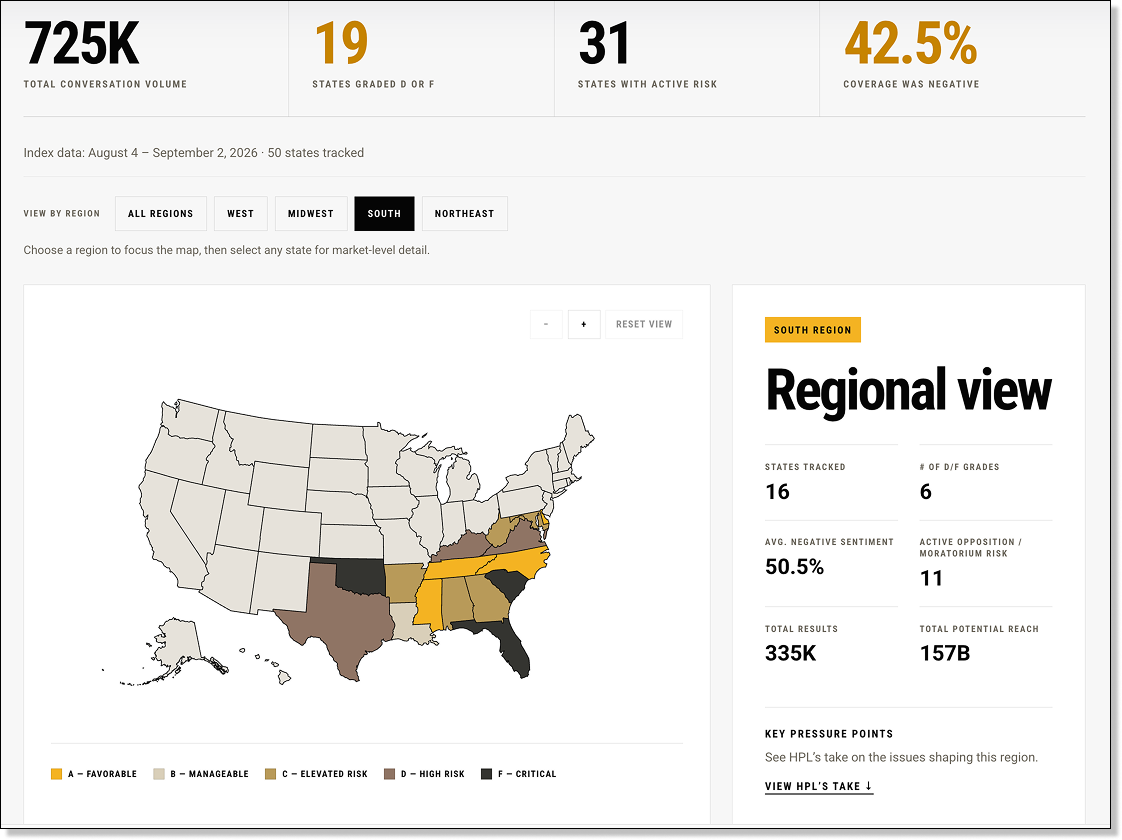
STATS OF THE MONTH
Georgia dropped a full letter grade this month. Pennsylvania's about to. Is your state next? → Check your state's live grade on the Narrative Climate Index
HERE'S WHAT'S HAPPENING
A uniquely bipartisan backlash against data centers shakes up the midterms
CNN · August 31, 2026
What do I need to know?
A CNN analysis of campaign ads found more than 99% of this year's data center-related ad spending was critical of AI infrastructure, spanning both parties. In Michigan, a congressional candidate filmed an ad from a farm field he said was at risk of becoming "a massive data center that'll jack up our energy bills." In suburban Missouri, both leading GOP candidates for a county executive seat spent their entire ad budgets vowing to stop data centers. A Gallup report cited in the piece found a 60-point drop in net support for local data center construction over the past 12 months, across party lines.
What to do with this:
Assume any project in a contested district is already campaign material, whether or not it's controversial locally yet. Candidates on both sides are reaching for this issue even in races with no direct data center angle. If you have projects in swing districts, your local government affairs team should know now whether it's already surfaced in ad tracking.
Cherokee Nation bans hyperscale data centers on tribal and trust lands
Yahoo · August 10, 2026
What do I need to know?
Principal Chief Chuck Hoskin Jr. announced a ban on hyperscale data center development across the Cherokee Nation's tribally owned and trust land, following a task force review that surveyed 1,593 citizens and found 64% opposed development (only 14% supported it).
What to do with this:
HPL's own research put this plainly a year ago: if you're not shaping your narrative, someone else will, and usually not in your favor. Cherokee Nation's task force is that dynamic playing out exactly as described, a structured, credible process defined the terms of the debate because no operator got there first. A bigger economic-impact number won't change that. What will is the "acknowledge early and engage officials proactively" step from our own crisis playbook, applied before there's a crisis
Trump's "Let Data Reign" defense collides with bipartisan backlash
AP News · August 26, 2026
What do I need to know?
President Trump used a Truth Social post to vigorously defend data centers, writing that "the only reason that communities throughout the U.S.A. should not want Data Centers is if they want to end up being backwards and poor" and warning that "China could not be happier with this anti Data Center movement." The post landed as polling showed deep bipartisan opposition: a March Gallup survey found 71% of Americans oppose data center construction in their area, including 75% of Democrats, 63% of Republicans, and 74% of independents. GOP candidate Jon Husted has called data centers "a local decision" and touted property tax cuts in communities that welcomed them, a notably softer position than Trump's.
What to do with this:
A rate hike sounds like a regulatory footnote until it shows up on someone's electric bill. If your state has a rate case moving, explain what the facility pays versus what residents pay, in plain terms, before that bill arrives. Salem shows what happens when nobody does.
IF ANY OF THIS HITS CLOSE TO HOME, THAT'S THE POINT..
We work with operators and utilities navigating exactly these dynamics, market by market. If you want to talk through what July's shifts mean for your specific project or state, grab 15 minutes below. No pitch, just a working session on your market's risk profile.
WORTH YOUR TIME
Pennsylvania's Gov. Shapiro signs executive order requiring binding grid commitments
Data Center Equipment sales tax exemption to a binding grid reliability commitment, a real reversal from Shapiro's earlier pro-growth posture, including a $20 billion Amazon commitment. "I'm using the full weight of my executive authority to block the objectionable, unwarranted projects and put the nation's strictest set of protections in place," Shapiro said.
Henry County, Virginia adopts one of the strictest data center zoning frameworks in the country
Rather than a moratorium, Henry County chose regulation: rezoning plus a special use permit, 1,000-foot setbacks, a 50 dBA noise limit, and mandatory closed-loop cooling. Worth watching as a model for counties that don't want an outright ban but also don't want to be the next Loudoun.
New Mexico's Supreme Court pauses air permitting for the 2.5 GW "Project Jupiter"
A reminder that opposition doesn't only come from city councils. Judicial intervention is becoming its own pathway for stalling major projects, and one that operates on a very different timeline than a permitting board.
One more look before your project's next council meeting:
→ See your state's full sentiment, grade, and moratorium risk
Explore HPL’s Data Center Narrative Risk Dashboard for a state-by-state view of media sentiment, public pressure, policy activity, and opposition risk across all 50 states.
View Dashboard